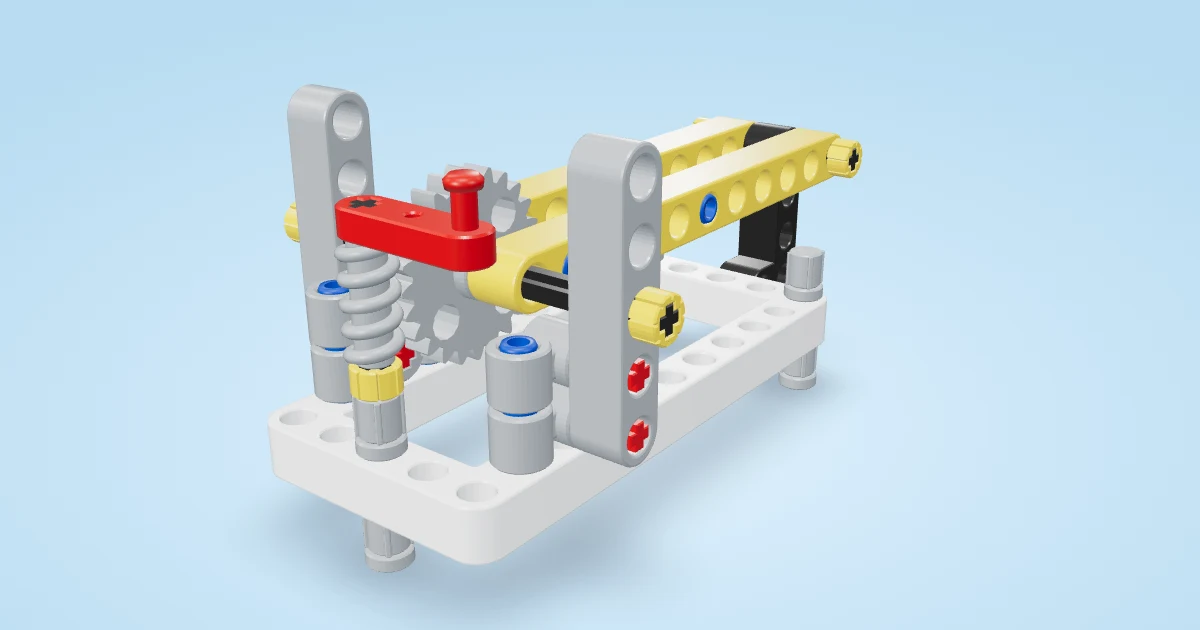
An excavator has three main sections: the undercarriage (tracks or wheels), the house (the cab and engine), which can swing all the way round, and the arm. The arm is three parts in a row. The boom lifts, the stick pulls the bucket through the ground, and the bucket scoops and dumps. On a real machine, hydraulic cylinders move all three.
Our Crank Excavator Arm has the same layout. It swaps the oil for worm gears and your hands:
| Part | Real excavator | Our model |
|---|---|---|
| Base | Tracks | 5×11 frame |
| Swing | House slews 360° | Worm on 28-tooth turntable |
| Boom | Boom cylinders | Worm on 24-tooth gear |
| Stick | Stick cylinder | Gripping pins, set by hand |
| Bucket | Bucket cylinder | Smooth pins, tipped by hand |
The house swings, and the arm goes with it
Wikipedia’s excavator article describes the house sitting on a rotating platform. High-pressure oil reaches the tracks through a hydraulic swivel at the centre, so the house can “slew 360° unhindered”. Everything above that ring turns together: cab, engine, boom, stick and bucket.
In the model, the whole yellow deck sits on a turntable. A worm on a long axle bites its 28 teeth, so 28 twists of the handle swing the digger once round. The handle is a yellow axle joiner, not a crank. The instructions explain why: a crank would hit the table, because that axle is only 1½ holes high. The turntables idea page and the radar post cover how a turntable carries a load, and the Spinning Radar is one of the two builds the instructions suggest first.
The boom lifts
HR Parts’ guide to excavator arms calls the boom the largest part of the arm. It pivots on the house, and boom cylinders raise and lower it, “and subsequently the entire arm”.
The model’s boom is two 11-hole beams, set at a 6-8-10 slope (36.9°) as built. A 24-tooth gear is pinned to the boom, and a worm under it is turned by a crank at the back. One crank turn moves one tooth, so each turn lifts the boom 15°: 24 turns for a full circle of the gear, far more than the boom can actually swing. Let go of the crank and the boom stays up, because a worm cannot be driven backwards by its gear. The worm gear post explains why, and the Worm-Gear Crane, the other suggested first build, shows the same trick on a smaller scale.
The stick and bucket
The stick is the digging section. Wikipedia describes it as giving “the digging movement needed to pull the bucket through the ground”. Modern machines pull the bucket toward themselves, while early power shovels pushed it away. HR Parts adds that the stick cylinder is mounted on top of the boom, and that the bucket cylinder works the bucket through a linkage.
The model keeps these two joints simple. The stick (two 9-hole beams) is held on black pins with friction ridges, so it stays wherever you set it. The bucket (two orange L-beams) hangs on smooth grey pins, so you can tip it to scoop and tip it back to dump. That is exactly the grip-or-swing choice from our pin guide.
Try it: drive the digger
Crank the boom, set the stick and swing the house. The lab uses the model’s real pivot positions to show where the bucket pin ends up:
Interactive: Excavator arm lab. Crank the Crank Excavator Arm’s boom, set its stick and twist its slew handle, and see the bucket pin’s reach and height from the build’s real geometry: 15° per boom crank turn, about 12.9° per slew twist. Five predict-then-check challenges.
Two things in the lab surprise most people. First, a small move at the base is a big move at the bucket. One crank turn is only 15°, but it lifts the bucket pin about 27 mm, because the pin is about 102 mm from the pivot. Second, the bucket covers about 740 mm in one full swing of the house. That is why slow worm drives suit this model: you can stop exactly over the dump box.
The angles of the boom and stick add up along the arm, just like the two-joint linkage in our arm angles post.
Model versus machine
- Power. Cylinders push and pull with oil pressure; the model uses your hand through two worm reductions.
- Holding. The model holds the boom with its worm, and the stick with friction pins.
- Control. A real operator moves several joints at once from the cab. Here you work one handle at a time, which makes each joint’s job easy to see.
Build it
The Crank Excavator Arm is a level 4 build of about 50 minutes, with no motor. Build a pile of bushes and pins as a sandpit, then try to move the whole pile into a box using only the handles.
Interactive: Check yourself. A few quick questions on the ideas in this guide, each with an explanation.
- Which part of an excavator raises and lowers the whole arm?
- On a real excavator, what moves the boom, stick and bucket?
- In the Crank Excavator Arm, how many crank turns lift the boom 15°?
- Why can you let go of the model’s boom crank halfway up?