What is a Technic frame used for?
A frame is a ready-made strong rectangle. An open frame is a rectangle of holes in one piece, so it never wobbles. It makes a perfect base, floor or roll cage. The hole in the middle keeps it light and leaves room for gears.
Try Gear Friends for freeComplete MightyCog booklet collection: 140 PDF booklets for $12.99. Instructions only; individual booklets remain free.
Explore the printable packTry it yourself
Try to bend a frame. Now try to bend four loose beams pinned into a rectangle.
Build it: 46 builds that teach frames
- ⚙️ Gear Friends: Three gears holding hands — spin one and they all dance. (level 1 of 5, about 8 minutes, 6 steps)
- ⏱️ Pendulum Metronome: Give it a nudge: tick… tock… tick. Move the wheel to another hole and count again! (level 1 of 5, about 10 minutes, 10 steps)
- 📐 Gear Reunion Bench: Count five small-gear turns before both marked gears return to their own starts. (level 2 of 5, about 20 minutes, 9 steps)
- 📐 Quarter-Phase Crank Bench: One shaft turns two equal-radius markers, a quarter turn apart. (level 2 of 5, about 20 minutes, 13 steps)
- 🌀 Coasting Wheel Bench: Spin a retained tabletop wheel gently, then measure how it slows down. (level 2 of 5, about 15 minutes, 8 steps)
- 🔀 Dual Output Gear Bench: One central input drives two unequal outputs: count each branch independently. (level 2 of 5, about 20 minutes, 14 steps)
- ⭕ Rim Distance Bench: Two unequal wheels share one shaft: equal turns, unequal rim travel. (level 2 of 5, about 15 minutes, 9 steps)
- 📐 Opposite Output Gear Bench: One input drives two equal-speed outputs in opposite directions through different paths. (level 2 of 5, about 20 minutes, 13 steps)
- 📐 Equal Spacing Gear Bench: Two independent gear pairs fit the same spacing, but their outputs turn differently. (level 2 of 5, about 20 minutes, 13 steps)
- 📐 Crank Orbit Bench: Trace a crank pin’s circle and compare its one-axis travel at equal angle steps. (level 2 of 5, about 15 minutes, 10 steps)
- 🛒 Drawbar-Steered Wagon: Explore how a drawbar turns a complete front axle beneath a fixed load frame. (level 3 of 5, about 55 minutes, 34 steps)
- 🔗 Parallel Motion Bench: Move a connecting bar around an arc without turning the bar itself. (level 3 of 5, about 30 minutes, 16 steps)
- ⏱️ Unequal Return Timing Bench: Turn one crank steadily and compare the unequal input angles of a rocker’s two strokes. (level 3 of 5, about 30 minutes, 15 steps)
- 🦾 Two-Joint Angle Bench: Separate a lower arm’s joint angle from its direction relative to the table. (level 3 of 5, about 30 minutes, 12 steps)
- 🐌 Worm Counting Bench: Count 24 input turns for one output turn, with both shafts retained. (level 3 of 5, about 35 minutes, 16 steps)
- 🔀 Differential Hand Bench: Turn a standard differential by hand and compare its two independently supported outputs. (level 3 of 5, about 25 minutes, 13 steps)
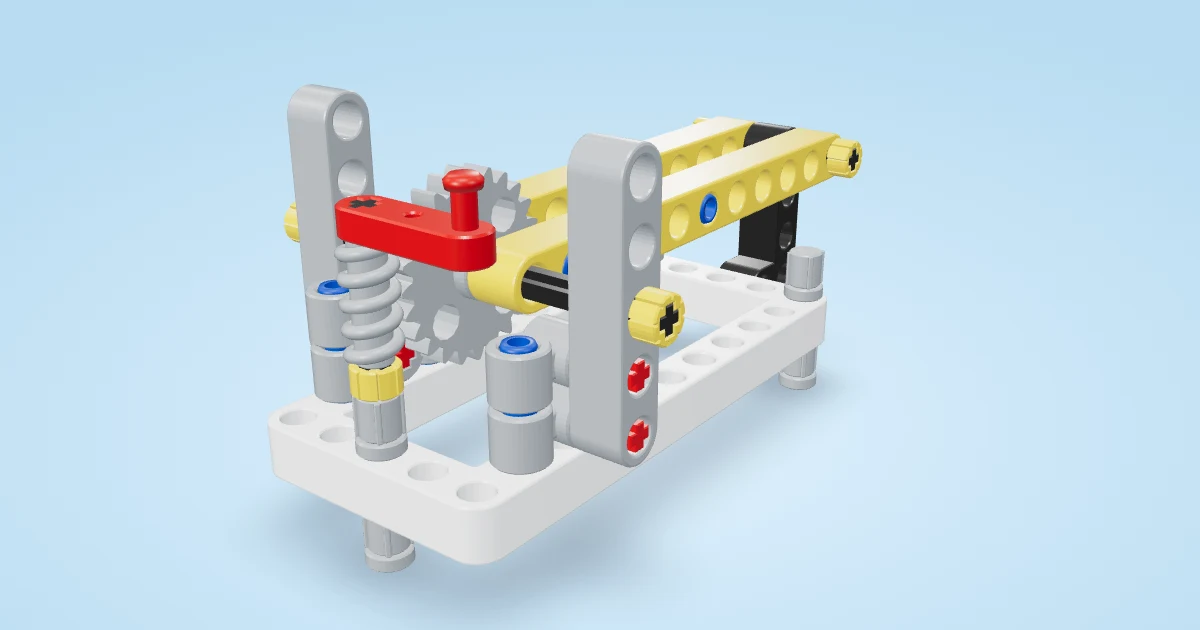 🏗️ Worm-Gear Crane: Crank the worm gear to lift the boom — then let go. It stays up by itself! (level 3 of 5, about 30 minutes, 15 steps)
- 🏰 Castle Drawbridge: Wind the handle and the heavy bridge slowly rises — and stays up when you let go. (level 2 of 5, about 30 minutes, 15 steps)
- 🌬️ Bevel-Gear Windmill: Turn the handwheel at the bottom — the sails spin at the top! (level 3 of 5, about 25 minutes, 16 steps)
- 🥚 Egg Beater: Turn the handle and two whisks whizz round in opposite directions. (level 2 of 5, about 20 minutes, 12 steps)
- ⏯️ Geneva Step Counter: Turn the handle smoothly — the pointer moves in jumps: click… wait… click! (level 3 of 5, about 30 minutes, 9 steps)
- 🚂 Quartered Coupling-Rod Locomotive: Couple two wheelsets with two rods, one quarter turn apart, and explore dead centre. (level 4 of 5, about 65 minutes, 35 steps)
- ↔️ Geared Transfer Shuttle: Turn a reduction drive continuously to send a captured carrier between two transfer positions. (level 4 of 5, about 50 minutes, 25 steps)
- 🗜️ Opposed Rack Centering Clamp: One pinion coordinates two captured rack jaws around a fixed centre. (level 4 of 5, about 55 minutes, 27 steps)
- 📏 Two-Scale Survey Cart: Roll a measuring cart with linked fine and coarse indicators, then calibrate its distance scale. (level 4 of 5, about 45 minutes, 13 steps)
- 🎯 Two-Stage Rack Positioner: Combine a two-stage reduction, shared shafts and a captured rack to position a slider in small increments. (level 4 of 5, about 50 minutes, 28 steps)
- 🛻 Bouncy Monster Truck: Four big wheels on four springy shock absorbers. Boing, boing! (level 4 of 5, about 45 minutes, 29 steps)
- 🚂 Floor Express: A remote-control locomotive with headlights, a chimney and a log wagon. (level 4 of 5, about 40 minutes, 17 steps)
- ⚖️ Balance See-Saw: A see-saw that is also a scale. Can one gear beat two? (level 1 of 5, about 12 minutes, 11 steps)
- ↔️ Twin-Length Timing Bench: Compare a short and a long freely swinging arm, and measure their full cycles. (level 2 of 5, about 20 minutes, 11 steps)
- ↪️ Bell-Crank Direction Bench: Turn a downward input into a sideways response with unequal perpendicular lever arms. (level 2 of 5, about 20 minutes, 11 steps)
- 🌉 Speed-Cancelling Gear Bridge: A 40–8–40 gear train: the middle turns five times, but the ends stay together. (level 2 of 5, about 15 minutes, 5 steps)
- ↔️ Pivot Position Bench: Two equal beams hang from different holes: compare their gravity lever arms. (level 2 of 5, about 20 minutes, 11 steps)
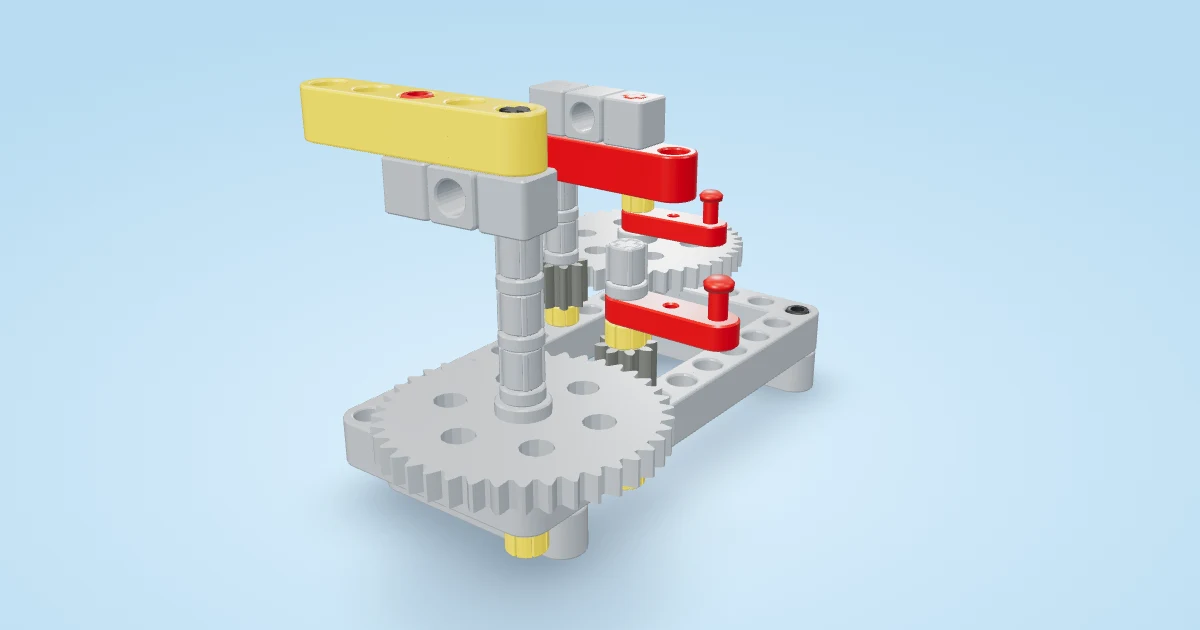 🧪 Gear Speed Lab: Two cranks, two gear pairs: one makes things FAST, one makes things STRONG. (level 2 of 5, about 20 minutes, 13 steps)
- 🔬 Compound Counting Bench: Two five-to-one stages multiply: count 25 input turns for one output turn. (level 2 of 5, about 20 minutes, 7 steps)
- 🌪️ Ripcord Top Launcher: Pull a toothed rack and watch two gear stages turn the top. (level 2 of 5, about 20 minutes, 18 steps)
- 🌀 Flywheel Friction Car: Vroom it on the floor, let go — and it keeps on rolling! (level 2 of 5, about 25 minutes, 5 steps)
- 🎯 Spring Catapult: Cock the arm, click the trigger, FIRE! A spring flings the ammo across the room. (level 2 of 5, about 25 minutes, 14 steps)
- 🐦 Woodpecker Automaton: Turn the handle and the woodpecker pecks: tok-tok-tok-tok! (level 2 of 5, about 20 minutes, 16 steps)
- 🚧 Parking Barrier Gate: A long striped barrier that lifts with a tiny turn — thanks to a heavy counterweight. (level 2 of 5, about 20 minutes, 9 steps)
- 📏 Rack Travel Bench: Turn a small gear and measure the straight travel of a captured rack. (level 3 of 5, about 25 minutes, 13 steps)
- 🎠 Chair-Swing Carousel: Crank faster and faster — the chairs fly out wider and wider! (level 2 of 5, about 35 minutes, 16 steps)
- 🪢 Belt-Drive Buggy: No gears touching: a loop carries the power from the motor down to the wheels. (level 3 of 5, about 35 minutes, 11 steps)
- 🛠️ Ratchet Car Jack: Crank the handle — click, click, click — and lift a toy car. Let go and it stays up! (level 3 of 5, about 35 minutes, 15 steps)
- 🔥 Twin-Piston Engine: See inside a car engine: two pistons race up and down in turns! (level 3 of 5, about 40 minutes, 22 steps)
- 🛢️ Nodding-Donkey Pump Jack: A slow crank rocks a long beam up and down — nod, nod, nod, all day long. (level 3 of 5, about 45 minutes, 30 steps)
In the classroom
- E2 Turning Things (Explorers, Foundation)
- I6 Bridges & Structures (Inventors, Intermediate)
Common engineering questions
How can I try frames at home?
Try to bend a frame. Now try to bend four loose beams pinned into a rectangle.
Which builds teach frames?
46 MightyCog builds teach it: Gear Friends, Pendulum Metronome, Gear Reunion Bench, Quarter-Phase Crank Bench and Coasting Wheel Bench and more. Start with Gear Friends: 6 steps, about 8 minutes.