What is the difference between black and grey Technic pins?
Pins join beams together — some hold tight, some let things swing. Black and blue pins have tiny ridges that grip, so the beams stay put. Grey and tan pins are smooth, so the joint can swing like a door hinge. Engineers pick the right pin for the job.
Try Tiny Roller for freeComplete MightyCog booklet collection: 140 PDF booklets for $12.99. Instructions only; individual booklets remain free.
Explore the printable packTry it yourself
Join two beams with a black pin and wiggle them. Now try a grey pin. Which one swings?
Build it: 69 builds that teach pins
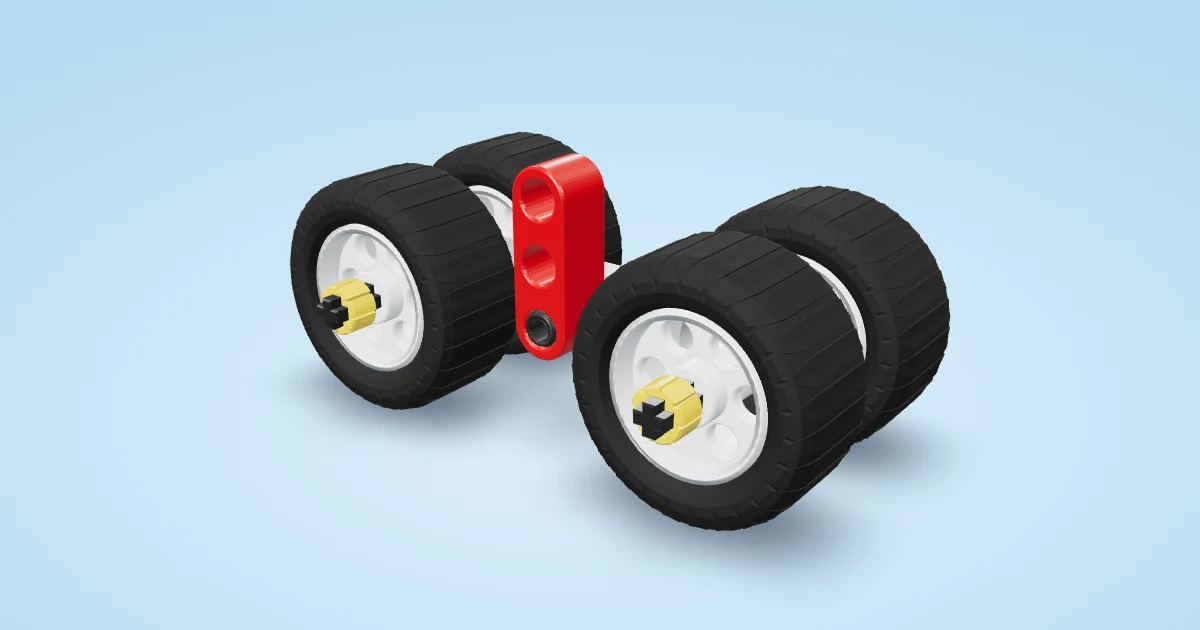 🚗 Tiny Roller: Your very first rolling car — only 13 pieces! (level 1 of 5, about 5 minutes, 6 steps)
- ⏱️ Pendulum Metronome: Give it a nudge: tick… tock… tick. Move the wheel to another hole and count again! (level 1 of 5, about 10 minutes, 10 steps)
- 📐 Gear Reunion Bench: Count five small-gear turns before both marked gears return to their own starts. (level 2 of 5, about 20 minutes, 9 steps)
- 📐 Quarter-Phase Crank Bench: One shaft turns two equal-radius markers, a quarter turn apart. (level 2 of 5, about 20 minutes, 13 steps)
- 🔀 Dual Output Gear Bench: One central input drives two unequal outputs: count each branch independently. (level 2 of 5, about 20 minutes, 14 steps)
- 📐 Opposite Output Gear Bench: One input drives two equal-speed outputs in opposite directions through different paths. (level 2 of 5, about 20 minutes, 13 steps)
- 📐 Equal Spacing Gear Bench: Two independent gear pairs fit the same spacing, but their outputs turn differently. (level 2 of 5, about 20 minutes, 13 steps)
- 📐 Crank Orbit Bench: Trace a crank pin’s circle and compare its one-axis travel at equal angle steps. (level 2 of 5, about 15 minutes, 10 steps)
- 🛒 Push Buggy: A sturdy buggy with a push bar held up by super-strong triangles. (level 2 of 5, about 15 minutes, 12 steps)
- 🛺 Pull-back Trike: A three-wheeler with a spring engine — twist the front wheel and it drives in circles! (level 2 of 5, about 20 minutes, 9 steps)
- 🦀 Lazy-Tongs Grabber: Squeeze the handles and the criss-cross arms shoot out to grab things far away! (level 2 of 5, about 20 minutes, 11 steps)
- 🎯 Spring Catapult: Cock the arm, click the trigger, FIRE! A spring flings the ammo across the room. (level 2 of 5, about 25 minutes, 14 steps)
- 🐦 Woodpecker Automaton: Turn the handle and the woodpecker pecks: tok-tok-tok-tok! (level 2 of 5, about 20 minutes, 16 steps)
- ✈️ F-16 Fighting Falcon (United States): A Technic-beam fighter jet with a bubble canopy, swept wings and red, white and blue paint. (level 2 of 5, about 40 minutes, 23 steps)
- ✈️ Concorde (United Kingdom): The white supersonic airliner with a slim body, a pointed nose and a graceful triangle wing. (level 2 of 5, about 35 minutes, 22 steps)
- 🚁 Mi-24 (Russia): The big Russian "flying tank" helicopter with two bubble cockpits and stubby side wings. (level 2 of 5, about 35 minutes, 23 steps)
- ✈️ Rafale (France): A French delta-wing jet with little canard wings by the cockpit and blue, white and red wingtips. (level 2 of 5, about 35 minutes, 22 steps)
- ✈️ Gripen (Sweden): A small, nimble Swedish delta jet with canards and blue-and-yellow tips. (level 2 of 5, about 35 minutes, 22 steps)
- ✈️ Tejas (India): A light Indian jet with a smooth tailless triangle wing striped saffron, white and green. (level 2 of 5, about 35 minutes, 21 steps)
- ✈️ MiG-21 (Russia): The pencil-thin Soviet jet with triangle wings and a nose that looks like a tube. (level 2 of 5, about 35 minutes, 21 steps)
- ✈️ Bf 109 (Germany): The narrow German fighter with square wingtips, a yellow nose and a big propeller. (level 2 of 5, about 35 minutes, 22 steps)
- ✈️ Eurofighter Typhoon (Germany): A pale grey canard-delta jet with big front canards and black, red and gold stripes. (level 2 of 5, about 40 minutes, 23 steps)
- ✈️ Su-27 (Russia): A big Russian fighter with two tail fins, painted in the blue, white and red of the Russian Knights. (level 2 of 5, about 35 minutes, 23 steps)
- ✈️ J-10 (China): A Chinese canard-delta jet with a big triangle wing and red-and-yellow trim. (level 2 of 5, about 35 minutes, 22 steps)
- 🚁 Dhruv (India): A nimble Indian helicopter in the red and white of the Sarang display team. (level 2 of 5, about 35 minutes, 20 steps)
- 🚁 AW101 (Italy): A big three-engine Italian-British helicopter with a long cabin and wide sponsons. (level 2 of 5, about 35 minutes, 21 steps)
- ✈️ Fiat G.91 (Italy): The little Italian jet of the Frecce Tricolori, in blue with green, white and red stripes. (level 2 of 5, about 35 minutes, 22 steps)
- ✈️ T-50 Golden Eagle (South Korea): A sleek Korean jet trainer in the black, white and yellow of the Black Eagles display team. (level 2 of 5, about 35 minutes, 22 steps)
- ✈️ Kfir (Israel): A desert-camouflaged Israeli delta jet with small canards and a long pointy nose. (level 2 of 5, about 35 minutes, 22 steps)
- ✈️ Draken (Sweden): The Swedish "dragon" jet with a double-delta wing: a long sharp inner triangle and a wider outer one. (level 2 of 5, about 35 minutes, 21 steps)
- ✈️ Hawk (United Kingdom): The bright red jet of the Red Arrows display team, with white and blue stripes. (level 2 of 5, about 35 minutes, 23 steps)
- ✈️ T-4 Blue Impulse (Japan): The chubby Japanese jet trainer of the Blue Impulse display team, in blue and white. (level 2 of 5, about 35 minutes, 23 steps)
- 🛒 Drawbar-Steered Wagon: Explore how a drawbar turns a complete front axle beneath a fixed load frame. (level 3 of 5, about 55 minutes, 34 steps)
- 🔗 Parallel Motion Bench: Move a connecting bar around an arc without turning the bar itself. (level 3 of 5, about 30 minutes, 16 steps)
- 🏎️ Steering Go-Kart: Turn the steering wheel and the front wheels really turn — just like a real car. (level 3 of 5, about 30 minutes, 25 steps)
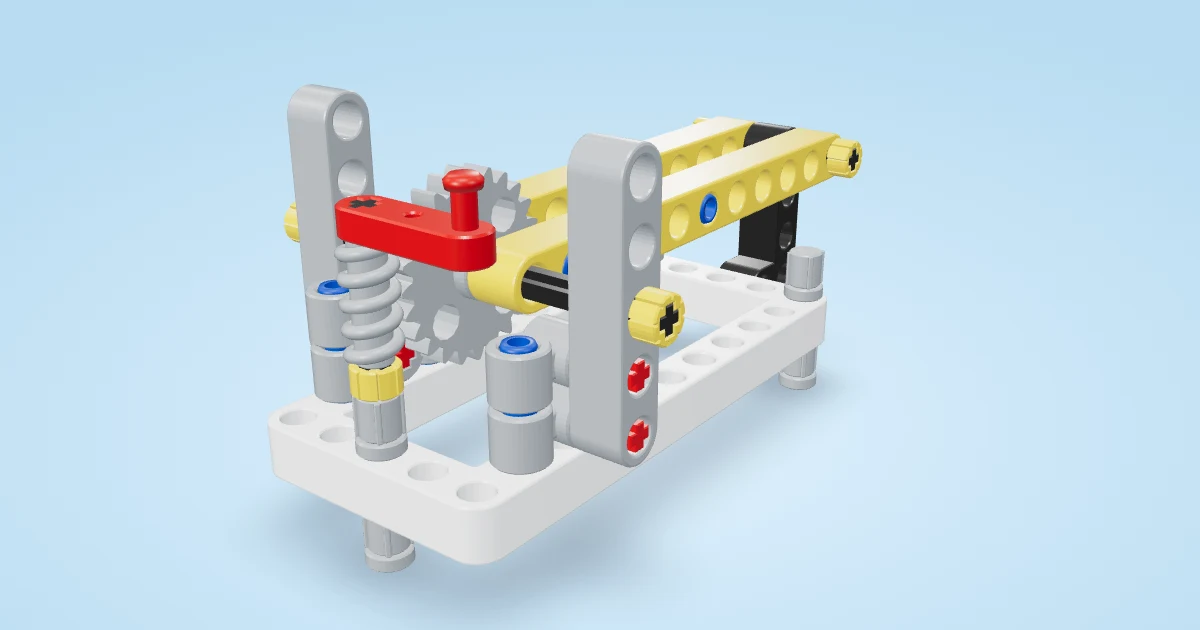 🏗️ Worm-Gear Crane: Crank the worm gear to lift the boom — then let go. It stays up by itself! (level 3 of 5, about 30 minutes, 15 steps)
- 🏰 Castle Drawbridge: Wind the handle and the heavy bridge slowly rises — and stays up when you let go. (level 2 of 5, about 30 minutes, 15 steps)
- ✈️ Spitfire (United Kingdom): The famous British fighter with the curvy wings, built from Technic beams and a spinning four-blade propeller. (level 3 of 5, about 40 minutes, 25 steps)
- ✈️ Boeing 747 Jumbo Jet (United States): The Queen of the Skies: a Technic-beam jumbo jet with its famous hump, four engines and a tall tail. (level 3 of 5, about 45 minutes, 29 steps)
- ✈️ Fokker Dr.I (Germany): The bright red three-winged plane of the "Red Baron" from the First World War. (level 3 of 5, about 40 minutes, 25 steps)
- ✈️ Zero (Japan): The long-winged Japanese fighter with a black nose and big red circles on its wings. (level 3 of 5, about 40 minutes, 25 steps)
- ✈️ An-225 Mriya (Ukraine): The giant Ukrainian cargo plane with six engines, a high wing and two tail fins. (level 3 of 5, about 40 minutes, 24 steps)
- ✈️ SR-71 Blackbird (United States): The long, all-black spy plane with a pointed nose, a huge triangle wing and two tail fins. (level 3 of 5, about 40 minutes, 24 steps)
- ✈️ Airbus A380 (France): The biggest passenger plane of all, with two full decks of windows and four big engines. (level 3 of 5, about 45 minutes, 30 steps)
- ✈️ Beaver (Canada): The Canadian bush plane with its wing on top, ready to reach lakes and forests far from any road. (level 3 of 5, about 40 minutes, 25 steps)
- ✈️ B-2 Spirit (United States): The black American "flying wing" with no tail at all and a zig-zag back edge. (level 3 of 5, about 40 minutes, 25 steps)
- ✈️ P-51 Mustang (United States): The shiny silver American fighter with a big four-blade propeller and a bubble canopy. (level 3 of 5, about 40 minutes, 25 steps)
- ✈️ Sopwith Camel (United Kingdom): The famous British First World War biplane, with two wings stacked one above the other. (level 3 of 5, about 40 minutes, 25 steps)
- ✈️ Embraer E-Jet (Brazil): A slim Brazilian airliner with two engines under its wings and a tall swept tail. (level 3 of 5, about 45 minutes, 29 steps)
- ✈️ Super Tucano (Brazil): A Brazilian turboprop with a long nose, a two-seat canopy and a fast four-blade propeller. (level 3 of 5, about 40 minutes, 23 steps)
- ✈️ Boomerang (Australia): A short, tough little Australian fighter in green and brown camouflage. (level 3 of 5, about 40 minutes, 22 steps)
- ✈️ C-212 Aviocar (Spain): A boxy Spanish transport plane with a high straight wing and two propellers. (level 3 of 5, about 45 minutes, 27 steps)
- ✈️ PC-12 (Switzerland): A white-and-red Swiss single-engine plane with long straight wings and a busy four-blade propeller. (level 3 of 5, about 40 minutes, 25 steps)
- ✈️ Fokker F27 Friendship (Netherlands): A Dutch high-wing airliner with two propeller engines and big round windows. (level 3 of 5, about 45 minutes, 27 steps)
- ✈️ M-18 Dromader (Poland): A big, bright yellow Polish crop-dusting and firefighting plane with long wings. (level 3 of 5, about 40 minutes, 25 steps)
- ✈️ Vinka (Finland): A small Finnish trainer plane in white with blue stripes, like the flag of Finland. (level 3 of 5, about 40 minutes, 23 steps)
- ✈️ Spirit of St. Louis (United States): The silver high-wing plane that flew across the Atlantic alone in 1927, with no front window at all. (level 3 of 5, about 45 minutes, 26 steps)
- ✈️ Blériot XI (France): The wood-and-cloth monoplane that first flew across the English Channel in 1909. (level 3 of 5, about 40 minutes, 24 steps)
- ↔️ Geared Transfer Shuttle: Turn a reduction drive continuously to send a captured carrier between two transfer positions. (level 4 of 5, about 50 minutes, 25 steps)
- 🛻 Bouncy Monster Truck: Four big wheels on four springy shock absorbers. Boing, boing! (level 4 of 5, about 45 minutes, 29 steps)
- 🚂 Floor Express: A remote-control locomotive with headlights, a chimney and a log wagon. (level 4 of 5, about 40 minutes, 17 steps)
- ↔️ Twin-Length Timing Bench: Compare a short and a long freely swinging arm, and measure their full cycles. (level 2 of 5, about 20 minutes, 11 steps)
- ↪️ Bell-Crank Direction Bench: Turn a downward input into a sideways response with unequal perpendicular lever arms. (level 2 of 5, about 20 minutes, 11 steps)
- 🌀 Coasting Wheel Bench: Spin a retained tabletop wheel gently, then measure how it slows down. (level 2 of 5, about 15 minutes, 8 steps)
- ⭕ Rim Distance Bench: Two unequal wheels share one shaft: equal turns, unequal rim travel. (level 2 of 5, about 15 minutes, 9 steps)
- ↔️ Pivot Position Bench: Two equal beams hang from different holes: compare their gravity lever arms. (level 2 of 5, about 20 minutes, 11 steps)
- 🦾 Two-Joint Angle Bench: Separate a lower arm’s joint angle from its direction relative to the table. (level 3 of 5, about 30 minutes, 12 steps)
- 🛠️ Ratchet Car Jack: Crank the handle — click, click, click — and lift a toy car. Let go and it stays up! (level 3 of 5, about 35 minutes, 15 steps)
- 📏 Two-Scale Survey Cart: Roll a measuring cart with linked fine and coarse indicators, then calibrate its distance scale. (level 4 of 5, about 45 minutes, 13 steps)
Common engineering questions
How can I try pins at home?
Join two beams with a black pin and wiggle them. Now try a grey pin. Which one swings?
Which builds teach pins?
69 MightyCog builds teach it: Tiny Roller, Pendulum Metronome, Gear Reunion Bench, Quarter-Phase Crank Bench and Dual Output Gear Bench and more. Start with Tiny Roller: 6 steps, about 5 minutes.