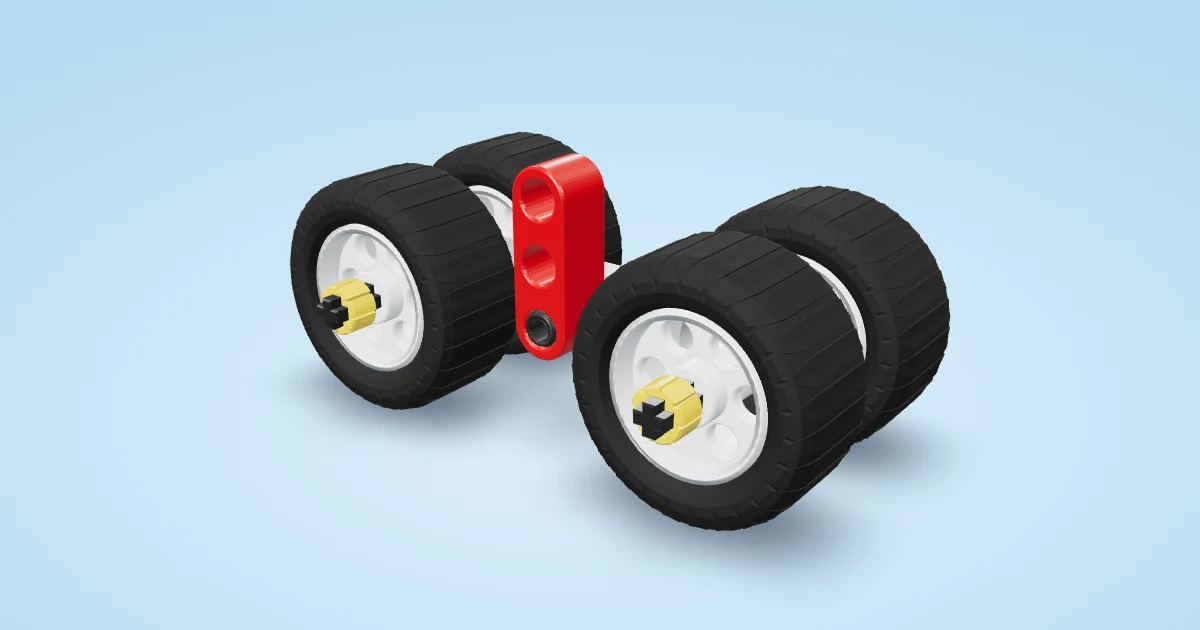
Most Technic-style pieces fall into six families: beams (strips with holes), pins (short pegs that join beams), axles (cross-shaped rods that turn things), bushes (stoppers that grip axles), connectors (blocks that join pins and axles at angles) and gears. Learn those six words and you can follow almost any instruction step. Below, each part has the plain name our instructions use, then the official name and part number from our parts list, handy when you search for spares.
The first Technic sets came out in 1977, under the names Expert Builder or Technical Sets depending on the country, and were renamed Technic in 1982, according to Wikipedia. Its article says the hole-and-pin “studless” style took over around 2000. Our builds use that studless style.
How lengths are counted
Everything is measured in holes. A 5-hole beam has five holes in a row, and a 3-long axle is as long as three holes are wide. On this site one hole is 8 mm, so a 15-hole beam is 120 mm long.
Beams and frames
- Beam (official name: *Liftarm Thick 1 x 5*, part 32316). Our builds use odd lengths from 3 to 15 holes. “Liftarm” is the official word for a beam without studs on top.
- L-beam (*Liftarm Thick 3 x 5 L-Shape*, 32526, and *2 x 4 L-Shape*, 32140). A beam bent into a square corner.
- Boomerang beam (*Liftarm Thick 1 x 9 Bent (7 - 3)*, 32271). A beam with a gentle bend.
- Thin beam (*Liftarm Thin 1 x 4*, 32449). Half as thick, for tight spaces and levers.
- Frame (*Liftarm Thick 5 x 7 Open Center*, 64179, and *5 x 11*, 64178). A ready-made rectangle of holes. See frames.
Pins
- Black pin (*Pin with Friction Ridges Lengthwise*, 2780). Joins two beams so they hold tight.
- Grey pin (*Pin without Friction Ridges*, 3673). Smooth, so whatever it joins can swing: a hinge.
- Blue long pin (*Pin 3L with Friction Ridges Lengthwise*, 6558). Goes through three layers.
- Red axle-pin (*Axle 1L with Pin with Friction Ridges*, 43093). Half pin, half axle: it plugs a round hole into a cross hole.
Which colour to use where has its own post: which pin should you use.
Axles and bushes
- Axle (*Axle 3*, 4519, up to *Axle 12*, 3708). A rod with a cross-shaped end. A gear or wheel with a cross hole grips it and turns with it. In a round hole, the axle spins freely. That is how a beam becomes a bearing.
- Bush (*Bush*, 3713). A stopper that grips an axle, so wheels and gears can’t slide off.
- Half bush (*Bush 1/2 Smooth*, 32123). A thinner stopper that doubles as a spacer so parts don’t rub. See bushes and spacers.
Connectors
- Cross block (*Axle and Pin Connector Perpendicular*, 6536). Joins an axle and a pin at a right angle.
- Split pin block (*Axle and Pin Connector Perpendicular Double Split*, 41678). An axle hole in the middle and two pin holes pointing sideways.
- Long pin-axle block (*Axle and Pin Connector Perpendicular 3L with 2 Pin Holes*, 42003).
- Axle joiner (*Axle Connector 2L*, 59443). Joins two axles end to end.
Gears
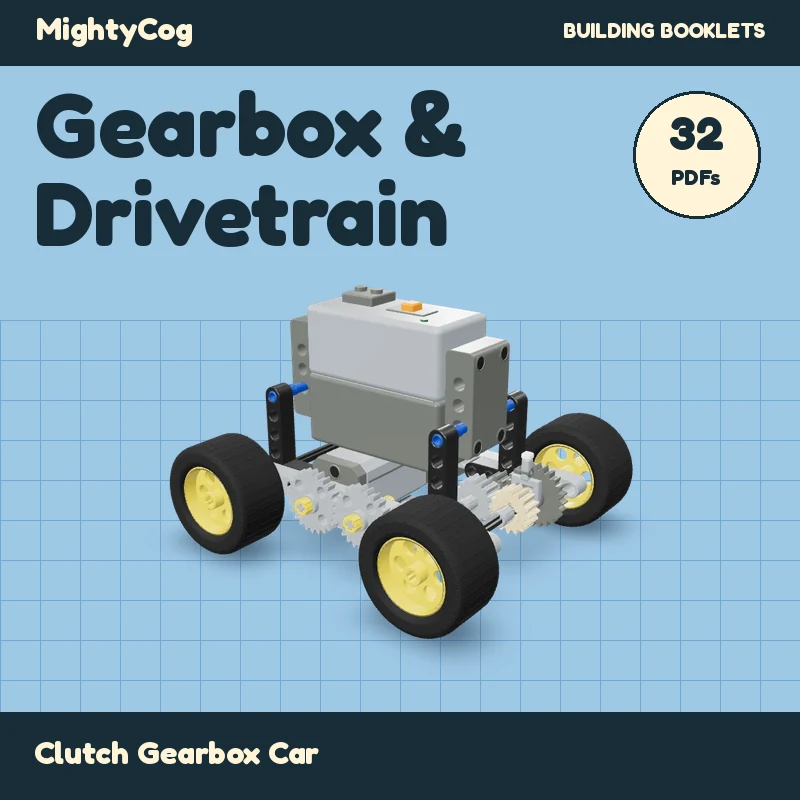
Our builds name gears by their teeth: the tiny gear (8 teeth, 3647), small gear (16), medium gear (24, 3648) and giant gear (40, 3649). Corner gears are bevel gears, with 12 or 20 teeth, that turn power round a corner. A worm gear (*Gear Worm Screw*, 4716) is a screw that turns a gear slowly and can’t be driven backwards. A clutch gear spins freely on its axle until a driving ring slides along and locks it, which is how the Clutch Gearbox Car changes gear.
Read a real step
The Crank Cruiser is a level 2 build of 9 steps and 24 pieces: two 11-hole beams, two 3×5 L-beams, four black pins, three 8-long axles, six half bushes, a tiny and a medium gear, four wheels and a hand crank. Its third step reads:
With the glossary, every word has a job: the axles are the car’s two wheel shafts, the holes are counted from one end of the beam, and the half bushes stop the axles sliding out. Its later steps add the medium gear driving the tiny gear, so one turn of the crank spins the wheels three times.
If you are starting from scratch, the Tiny Roller is a gentler first read.
Which parts do our builds really use?
Famous parts aren’t always common ones. Count every step of every build on the site and the plain parts win by a long way. Guess first, then check:
Interactive: Which parts do our builds use?. Pick a family of parts (pins and bushes, beams, axles, connectors or gears) and see which are placed most often across every build on the site, with official names and part numbers. Five predict-then-check challenges.
When your collection grows, how to sort and store parts shows why sorting by type beats sorting by colour.
Interactive: Check yourself. A few quick questions on the ideas in this guide, each with an explanation.
- How is a beam’s length counted?
- What does a bush do?
- Which pin lets a joint swing freely?
- An axle has a cross-shaped end. Why does that matter?